
Otis was diagnosed with two heart defects at the 20-week scan. After many bumps in the road, little Otis is now thriving. Mum, Millie, tells us their story:
(The photos in this story were taken by and belong to the author, depicting their family’s personal journey.)
At our 20-week scan, we found out that our baby had congenital heart disease (CHD). We were transferred to a fetal medicine unit where we saw consultants who were able to tell us exactly what was wrong.
Otis was diagnosed with coarctation of the aorta (COA) and a large ventricular septal defect (VSD). I chose to have an amniocentesis test to rule out DiGeorge syndrome and, thankfully, the test results were clear. Throughout my pregnancy, we attended regular scans at a larger hospital, plus weekly growth scans due to Otis dropping off the chart.
I was booked in for an induction at 38+6 weeks gestation as we lived one and a half hours away from the hospital where Otis needed to be delivered. The doctors wanted to ensure they could get everything ready for Otis before he arrived.

Otis was born on the 6th of September, weighing 6lbs 15oz. He was taken straight to the neonatal intensive care unit (NICU), and around three hours later, I finally got to meet my beautiful baby. Otis was closely monitored over the next few days and, once the duct closed, he was doing well. The surgeons wanted Otis to increase his weight before surgery, so we were discharged after six days.

Following Otis’ discharge, we had weekly appointments for echocardiograms and weight checks. Otis started to lose weight quickly. He became extremely breathless, fussy with feeding, and was struggling overall.
On the 2nd of October, Otis was admitted to the high dependency unit (HDU). He required high-flow vapotherm and needed to be NG tube fed. I was told he needed surgery as soon as possible and this was scheduled for the 5th of October. However, Otis then developed a temperature, and his infection markers were raised, so his surgery was delayed.

Finally, Otis was taken for surgery on the 11th of October. I felt sick all day. The surgery took nine hours in total. After his surgery, the surgeon informed us that Otis had a hypoplastic of the arch and his VSD was a lot larger than they originally thought and in an extremely awkward place. His surgeon managed to fix both problems which was something we had all anticipated he’d be able to do.

Otis was in the paediatric intensive care unit (PICU) for five days. During this time, he responded well to all the medication and his stats remained stable. Otis’ drains were removed on day two and he was extubated on day three.

We were then moved back to the HDU and Otis was placed on low-flow vapotherm. He still had his pacemaker in, and lines in his groin and neck. We spent a further four days in HDU. They removed his lines on day two, followed by his pacemaker on day three. Otis was then taken off all oxygen and finally, after three long weeks, I was able to feed my baby again. He latched well and, with lots of perseverance, he was back to feeding from me and gaining weight.
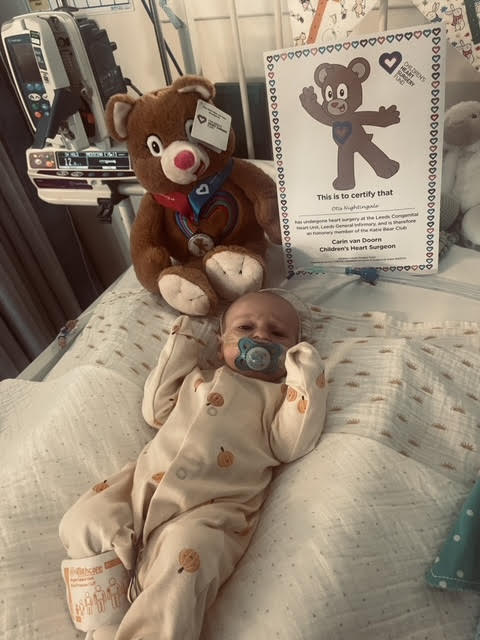
We were then transferred to the ward where we initially believed we would only spend a couple of days. However, Otis had another temperature and his infection markers were raised again. His sodium levels were also particularly low, and his potassium levels were extremely high.
After a week on the ward, and lots of trial and error with medications, we were finally discharged and allowed to take him home. Those four weeks in hospital were honestly traumatising, but the staff there were incredible.

We are now eight weeks post-surgery and Otis weighs 9lbs 11oz. He is still exclusively breastfed, and doing amazingly well. Otis’ scar has healed nicely, too. We still have regular follow-ups at the hospital, but so far so good, and thankfully he shouldn’t need any more surgeries in the future.
Our heart babies are so resilient and are little warriors! I am so proud of Otis and how well he’s doing.

You must be logged in to post a comment.